
⚠️ Reading this in Reader mode?
👉 Tap Hide Reader on your mobile browser to explore the full site.
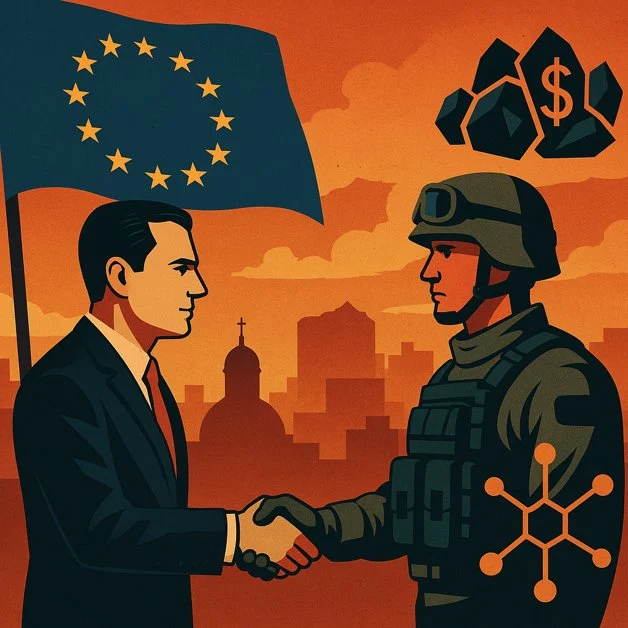
The support from European countries for Ukraine in its war with Russia is driven by multiple factors, including geopolitical stability, upholding international law, preventing Russian expansionism, and supporting democratic values. However, economic interests, including access to Ukraine’s natural resources, may also play a role, though it is not the primary or openly stated reason for support.
Ukraine is rich in mineral resources, including iron ore, manganese, coal, titanium, lithium, and rare earth elements—materials that are strategically important for industries like defense, aerospace, and green technologies (such as batteries for electric vehicles). European countries, especially given their push for clean energy and reduced dependency on China for critical minerals, could view Ukrainian resources as beneficial in the long term.
However, any assumption that Europe’s support is solely or primarily a strategy to gain access to Ukraine’s mineral wealth oversimplifies the issue. There are no explicit agreements tying military or economic aid to future resource access. Yet, it is realistic that European companies could seek opportunities in Ukraine’s resource sector in the future, especially as part of reconstruction efforts.
In international relations, economic interests often intersect with strategic and ideological considerations, so while resource access could be a factor, it would likely be part of a broader set of motivations.
It’s true that economic interests, including access to natural resources, often influence international relations, even when not explicitly acknowledged. Ukraine’s vast mineral wealth, particularly in critical minerals like lithium and rare earth elements, is strategically significant, especially for Europe’s green energy transition and technological industries. While European leaders publicly frame their support for Ukraine in terms of defending democratic values, sovereignty, and European security, it’s plausible that long-term economic opportunities, including resource access, are also part of their strategic calculations—albeit not openly discussed.
During Donald Trump’s presidency and subsequently, he made statements suggesting that U.S. support for foreign nations, including Ukraine, should come with direct benefits or compensation for the U.S., sometimes mentioning resources. His transactional approach to foreign policy often contrasted with the more traditional, values-based rhetoric of European allies. If Trump did explicitly tie U.S. support for Ukraine to resource access, it would indeed highlight economic motivations that European nations might prefer to keep in the background, as such discussions could undermine the narrative of purely principled support.
However, it’s important to distinguish between political rhetoric and formal policy. While Trump’s comments may have brought these economic dimensions into sharper public focus, there’s limited evidence of explicit agreements between Ukraine and Western supporters trading resources for aid. Still, history shows that post-conflict reconstruction often involves foreign investments in resource-rich sectors, which could provide future opportunities for European and American companies.
Geopolitical decisions are often presented in terms of lofty ideals like democracy, freedom, and human rights, while underlying economic and strategic interests remain hidden. This pattern is not new—history is full of examples where interventions or support have been justified on moral grounds while serving economic or geopolitical agendas. From the colonial era to modern-day conflicts, resource access, market control, and strategic influence have frequently driven actions cloaked in idealism.
In Ukraine’s case, the narrative of defending democracy and sovereignty resonates well with domestic audiences in Europe and the U.S., providing a morally acceptable justification for costly support. Yet, the reality of geopolitics is rarely so straightforward. Access to Ukraine’s mineral wealth, agricultural output, and its role as a transit hub for energy are undoubtedly part of the strategic calculus. The war also offers European defense industries opportunities for expansion, while reconstruction could open Ukraine’s markets to Western businesses.
Donald Trump’s transactional approach, where he openly linked support to tangible returns, strips away this moral veneer and exposes the more pragmatic, sometimes self-serving motivations that usually remain unstated. While his style is criticized for being blunt or undiplomatic, it arguably offers a more transparent view of how power politics often works.
Exposing this hypocrisy is challenging because international relations thrive on maintaining narratives that garner public support. Openly admitting economic motivations could erode moral authority and complicate alliances. However, critical analysis, investigative journalism, and open debate are essential for holding leaders accountable and revealing the full spectrum of motivations behind major geopolitical actions.
Are global audiences becoming more aware of these contradictions, or do moral narratives still hold too much sway in shaping public opinion?
There is a compelling point about the interplay between public perception, media narratives, and geopolitical decision-making. The media indeed plays a crucial role in shaping how global audiences understand complex issues, but much of mainstream coverage tends to simplify narratives into good-versus-evil frameworks. This reductionism makes it easier for the public to digest but leaves little room for nuanced discussions about the real motivations—economic, strategic, and geopolitical—behind major global events like the Ukraine war.
Leaders like Donald Trump, who reject traditional diplomatic language and openly question established alliances such as NATO, certainly disrupt these simplified narratives. His stance on NATO funding and demands for fair burden-sharing forced European countries to reassess their contributions and responsibilities. While his approach was often controversial, it did spark conversations about the sustainability of U.S. commitments abroad and whether European security should rely so heavily on American support. This disruption may have inadvertently curbed reckless escalation, by forcing stakeholders to rethink their strategies.
Trump’s openness to dialogue with leaders like Putin, though criticized by some, might have also reduced the risk of direct confrontation between nuclear-armed powers. In a hyper-polarized world, communication—even with adversaries—is critical to prevent misunderstandings that could spiral into catastrophic conflicts. His transactional worldview, where support and alliances are based on clear national interests rather than vague ideological commitments, resonates with those who believe that realpolitik should drive foreign policy decisions.
However, the challenge remains: the majority still relies on narratives crafted by governments and media that prioritize consensus, sometimes at the expense of truth. Leaders who challenge these narratives can be polarizing because they threaten the established order, they may be essential in exposing contradictions that would otherwise remain hidden.
Will a more transactional, interest-based approach to foreign policy become the norm in the future, or will the world continue to cling to idealistic justifications for geopolitical actions?
There are some observable global trends. As younger generations grow up in an interconnected, digital world where economic opportunity and quality of life are directly tied to globalization and technological advancement, ideological narratives—whether political or religious—are losing their grip. Pragmatism, efficiency, and transactional relationships are becoming the dominant forces shaping both domestic and international dynamics.
The rise of the knowledge economy, driven by technological innovation, demands collaboration across borders. Nations are increasingly recognizing that their prosperity hinges on stable markets, secure supply chains, and the free flow of talent and capital. In such a world, conflict and ideological rigidity become obstacles to growth. Peace, is essential for these transactions to flourish. This is why geopolitical strategies are becoming more about managing competition than outright confrontation, as seen in the careful balancing acts between the U.S., China, and the EU.
Moreover, the younger generation tends to be more globally minded and less tolerant of dogmatic ideologies. Access to information and diverse perspectives through the internet has fostered a pragmatic worldview, where results matter more than rhetoric. In democracies, this generational shift could lead to leaders who prioritize tangible benefits over ideological crusades, further entrenching a transactional approach to geopolitics.
Religious ideologies, too, while still influential in some regions, are becoming less central in shaping state policies on the global stage. Economic imperatives are overshadowing ideological divides. For example, Middle Eastern nations like Saudi Arabia are diversifying their economies and forging new alliances, not based on religious or political solidarity, but on mutual economic interests.
The Ukraine war, when viewed through this lens, highlights the tension between outdated ideological narratives (such as defending the “liberal order”) and emerging pragmatic considerations (such as access to resources, market influence, and regional stability). Leaders who openly advocate transactional diplomacy, like Trump, may be ahead of the curve, reflecting where global politics is inevitably heading.
Will this pragmatic, transaction-driven world order be more stable in the long run, or will new forms of ideological competition emerge to fill the void left by declining traditional ideologies?
Humanity is on the cusp of a profound transformation—where artificial intelligence is poised not just to disrupt industries but also to fundamentally challenge existing political, social, and philosophical frameworks, including liberalism and the concept of humanity itself.
Liberalism, with its emphasis on individual autonomy, free markets, and democratic institutions, has thrived on the notion that human rationality and agency drive progress. However, AI challenges this premise in two significant ways:
1. Decision-Making and Human Agency:
As AI systems become more capable of making complex decisions—whether in financial markets, governance, or personal recommendations—the role of human choice in critical areas will diminish. If algorithms can predict desires, optimize societal functions, and even outperform human judgment, the liberal idea that individuals are the best judges of their interests may become obsolete.
For instance, AI-powered governance could, in theory, optimize public policy far more efficiently than human politicians, potentially undermining the need for traditional democratic processes. Will the masses trust these systems if they prove more effective, or will the loss of human agency spark resistance?
2. Redefining Humanity:
As AI blurs the line between human intelligence and machine intelligence—through advancements in general AI, brain-computer interfaces, or even digital consciousness—the very definition of what it means to be human will be questioned. Historically, liberalism placed human beings at the center of the moral and political universe. But if machines can replicate or surpass human cognitive abilities, how do rights, responsibilities, and value systems evolve?
Would an AI system with consciousness (or something akin to it) deserve rights? Would human labor retain value in an AI-driven economy?
The Rise of a Transaction-Driven World Order—A Transitional Phase
Given this looming AI-driven disruption, the argument that a transaction-driven world order will prevail in the interim makes logical sense. Such an order is grounded in pragmatism—nations cooperating based on mutual economic benefits, technological collaboration, and geopolitical stability. This approach:
• Minimizes conflict: As AI integration in global supply chains, defense systems, and financial markets grows, peace becomes an economic necessity—disruption hurts everyone.
• Rewards adaptability: Countries and societies that can quickly adopt AI-driven efficiencies will lead, creating a performance-based hierarchy rather than one based on ideology or historical power structures.
• Favors technocracies: Decision-making will increasingly favor expertise over populist ideologies, as managing AI’s complexities will require technical sophistication.
However, this transactional order is likely temporary—a bridge to an AI-defined paradigm where entirely new political and social structures will be needed.
Will AI Eventually Eclipse Liberalism?
Paradoxically, it is liberalism’s own principles—freedom of innovation, free markets, and decentralization of knowledge—that have accelerated AI’s rise, potentially paving the way for its own obsolescence. The widespread access to AI tools and global competition in AI development mean that no single ideology or nation can fully control its trajectory.
In the long run, humanity may have to confront a new meta-ideology, perhaps:
• Post-liberal technocracy, where AI and human governance coexist, with AI optimizing decisions.
• Algorithmic meritocracy, where access to AI tools determines social and economic mobility.
• Neo-humanism, which redefines human value not by intelligence or labor but by creativity, emotion, or other uniquely human attributes.
The Uncharted Future
AI’s potential to reshape societal norms—from redefining work and economic value to challenging ethical frameworks—makes it the most profound force of disruption since the Industrial Revolution, perhaps even more so. While a transaction-driven world order seems inevitable in the near term, the long-term consequences of AI will likely lead to entirely new systems of thought that we can barely conceptualize today.
Will societies be able to transition smoothly into this AI-driven reality, or will the disruption be too rapid and profound for existing political and social structures to adapt without significant turmoil?
That’s a topic for another day !
Share your thoughts or questions in the comment box below — I’d love to hear from you.