
⚠️ Reading this in Reader mode?
👉 Tap Hide Reader on your mobile browser to explore the full site.
“Your maid took unannounced leave—again. The dishes are piling up, the floor’s a mess, and you’re scrambling before guests arrive. What if you could just open an app and have help arrive within minutes?”
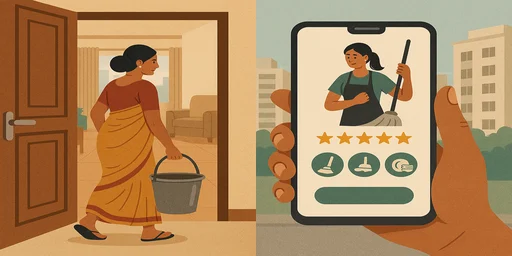
It sounds convenient. And it’s becoming real. A growing number of app-based platforms now promise exactly this—on-demand domestic help, from toilet cleaning to cooking and child care, all just a few taps away.
But as this model gains ground in Indian metros, it raises a deeper question: Are we solving a problem—or creating a more complex one?
The Domestic Work Dilemma Today
For many urban households, managing domestic help has become a daily struggle. Finding a reliable maid through informal networks is hit or miss. Helpers often arrive late, take long unscheduled breaks, and change jobs for a marginal pay hike. There are no standard rules around pay, tasks, leave policies, or notice periods. Trust is built slowly, but even long-standing arrangements can break without warning.
At the same time, the demand for help has surged—thanks to rising incomes, dual-income families, and increasingly nuclear homes. The current informal system simply cannot meet these modern expectations efficiently.
Frustrations Faced by Employers
It is important to recognize that frustrations exist not only for workers but also for employers within the traditional model. Many households experience issues such as:
Frequent tardiness and irregular working hours
Lack of professionalism in completing agreed-upon tasks
Excessive mobile phone use during work hours
Shirking of responsibilities or selective performance of chores
Repeated demands for advances or loans, sometimes leading to awkward tensions
Poor cleanliness standards
These challenges have left many employers feeling trapped between personal loyalty and daily operational difficulties.
It is partly in response to these repeated frustrations that some households are now turning to app-based platforms — seeking greater reliability, standardized work expectations, and easier mechanisms for feedback and replacement.
Enter the Aggregator: A Glimpse of Order
Into this chaos step a host of startups: BookMyBai, Broomees, UrbanClap, and more. They promise to bring structure, transparency, and reliability to the hiring of domestic workers.
Much like Zepto delivers groceries or Uber gets you a cab, these platforms aim to:
- Offer on-demand or scheduled services
- Set clear pricing, upfront
- Define scope of work and duration
- Let users rate and review workers
- Replace no-shows with backups, often within hours
It’s easy to see the appeal—especially for younger users, or those who’ve faced repeated disappointments in the traditional system.
The Hidden Costs of App-Based Help
Yet, the Uberisation of domestic work brings with it a new set of challenges—less visible, but potentially more serious.
- Loss of continuity: With rotating workers and on-demand hiring, households lose the trust and familiarity built over time with a regular maid.
- Rigid work structures: Apps define services narrowly—“bathroom cleaning,” “vessel washing”—but real homes require flexible multitasking.
- Higher per-visit cost: One-off bookings often work out costlier than monthly salaried arrangements.
- Platform dependency: Users are bound by app policies, surge pricing, and opaque cancellation charges.
And what about the workers themselves?
- Many are treated as interchangeable, without benefits, leave, or social security.
- Reviews and ratings can be biased or vindictive, without recourse.
- Long travel times, irregular hours, and lack of job security persist—but now with algorithmic control.
Domestic Work vs Other App-Based Models: A Critical Comparison
Let’s compare:
| Feature | Uber (Cabs) | Zepto (Groceries) | Urban Company (Repairs/Cleaning) | Maid Aggregator Apps |
|---|---|---|---|---|
| Task repeatability | High | Very High | Medium | Low |
| Worker continuity needed | No | No | Sometimes | Often yes |
| Personal trust factor | Low | Zero | Medium | High |
| Service customization | Low | None | Medium | High |
| Emotional labour involved | None | None | None | Significant |
Unlike delivery agents or cab drivers, domestic workers enter a household’s private, emotional space. The relationship cannot be reduced to a checklist and a rating.
Ethical and Structural Concerns
If app-based temporary work removes stability even from service professionals, what happens when home-based care—intimate, personal, and largely performed by women—is treated the same way?
Legal protections are minimal. Domestic workers are often excluded from formal labor laws, and platforms classify them as “independent service providers”—thus avoiding responsibility for insurance, maternity leave, or safety nets.
Meanwhile, the tech platforms focus on scale, not worker well-being. This raises a real fear: Are we using technology to standardize convenience while institutionalizing inequality?
A Possible Middle Path
All is not lost. Thoughtful design can bridge the gap between tech-driven convenience and human continuity.
- Subscription-based models: Apps that allow recurring bookings with the same worker, with backup options for emergencies.
- Digitally assisted, not digitally dominated: Use tech for scheduling and payments—while preserving trust-based relationships.
- Worker-led cooperatives: Platforms run by domestic workers themselves, giving them fair pay, dignity, and voice.
The goal should be to formalize without dehumanizing.
Conclusion: Beyond Convenience—The Choices We Make
The Uberisation of domestic work may be inevitable—but its form is not. As users, citizens, and employers, we must ask:
Are we building systems that empower all stakeholders, or only the consumer?
Convenience is good. Fairness is better.
And when it comes to someone who cooks your meals, cleans your home, or cares for your child—maybe both matter equally.
💬 Thoughts or reflections? I’d love to hear from you — please leave a comment below.